Jack Steinberger
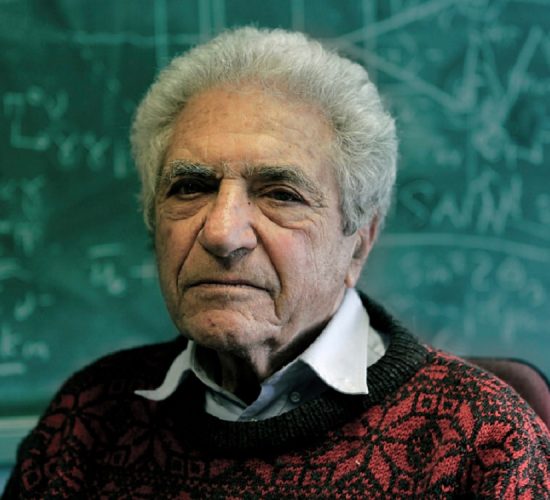
Jack Steinberger showed that there is more than one kind of neutrino. With Leon Lederman and Melvin Schwartz he built the first beam of neutrinos and used it to discover the muon neutrino, work for which the three shared the 1988 Nobel Prize in Physics.
Life and Career
Hans Jakob Steinberger was born in Bad Kissingen, Germany. In 1934, at the age of 13, he was sent to the United States to escape Nazi persecution. He studied chemistry at the University of Chicago and, after wartime service at the MIT Radiation Laboratory, returned to Chicago for a PhD under Enrico Fermi. His thesis on muon decay already pointed to the involvement of two neutral particles.
At Columbia University he joined Lederman and Schwartz in an experiment at Brookhaven National Laboratory. In 1962 they produced a beam of neutrinos from decaying pions and found that these neutrinos created muons, never electrons. The conclusion: the neutrino that accompanies the muon is a different particle from the one that accompanies the electron.
In 1968 Steinberger moved to CERN in Geneva. He led the ALEPH experiment at the Large Electron-Positron collider, one of the experiments that showed in 1989 that there are exactly three types of light neutrino. He continued to work in physics well into his nineties and died in Geneva in 2020.
Why His Work Matters Here
Steinberger’s neutrino beam turned a nearly invisible particle into a tool that could be aimed and studied. The three neutrino flavours he helped establish are the same ones whose oscillation earned Takaaki Kajita and Arthur B. McDonald the 2015 Nobel Prize.