Francis Halzen
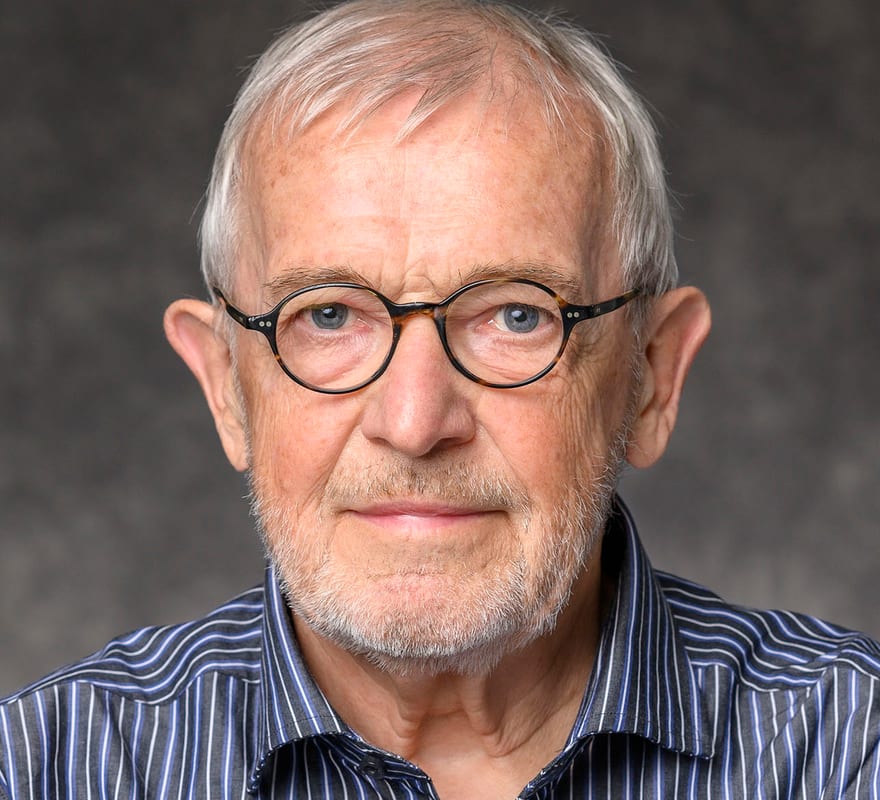
Francis Halzen turned a cubic kilometre of Antarctic ice into a telescope for neutrinos. As principal investigator of the IceCube Neutrino Observatory he led the first detection of high-energy neutrinos from beyond our solar system, opening the field of neutrino astronomy. On 6 October 2026 the Royal Swedish Academy of Sciences awarded him the Nobel Prize in Physics for decisive contributions to IceCube and the discovery of high-energy neutrinos of astrophysical origin.
Life and Career
Halzen was born in Belgium and received his master’s degree and PhD from KU Leuven. He joined the physics faculty of the University of Wisconsin–Madison in 1972, where he is Vilas Research Professor and Gregory Breit Distinguished Professor of Physics. He is also a Distinguished Affiliated Professor at the Technical University of Munich, where he works with Elisa Resconi’s group on the sources of cosmic neutrinos.
A theorist by training, he worked at the meeting point of particle physics, astrophysics and cosmology. His early career coincided with the development of the Standard Model, and with Alan D. Martin he wrote Quarks and Leptons, a textbook still used in universities around the world.
From an Idea to a Detector
In the 1980s Halzen took up a problem that many considered unsolvable: how to catch the rare high-energy neutrinos arriving from deep space. His answer was to use the clear, deep ice at the South Pole as a natural detector. The AMANDA experiment proved the method, and IceCube, completed in 2011, scaled it up: 5,160 light sensors on vertical strings between about 1,450 and 2,450 metres below the surface, recording the faint blue Cherenkov light that follows a neutrino interaction.
The results came step by step. In 2013 IceCube reported the first high-energy neutrinos of cosmic origin, named Physics World’s Breakthrough of the Year. In 2017 a single neutrino was traced to a flaring galaxy, TXS 0506+056, giving the first evidence of a source of high-energy cosmic rays, a question open since their discovery more than a century earlier. In 2023 the collaboration published the first view of our own Milky Way in neutrinos. Elisa Resconi summed up his role in the project: “he is the heart and soul of this research.”
Before the Nobel Prize, Halzen received the Balzan Prize (2015), the Bruno Pontecorvo Prize (2018), the IUPAP Yodh Prize (2019), the Bruno Rossi Prize (2021) and the Homi Bhabha Award (2021), among others.
Why His Work Matters Here
IceCube shows how much a single rare interaction can reveal when enough matter is watched carefully. Neutrinovoltaic research starts from the same physics and asks a different question: not whether an interaction happened, but how the energy handed over by such interactions, together with other ambient inputs, can be converted in a material. IceCube is an independent international collaboration, and the Neutrino® Energy Group is not part of it. In short: science detects them in ice; we put them to work in a device.