Albert Einstein
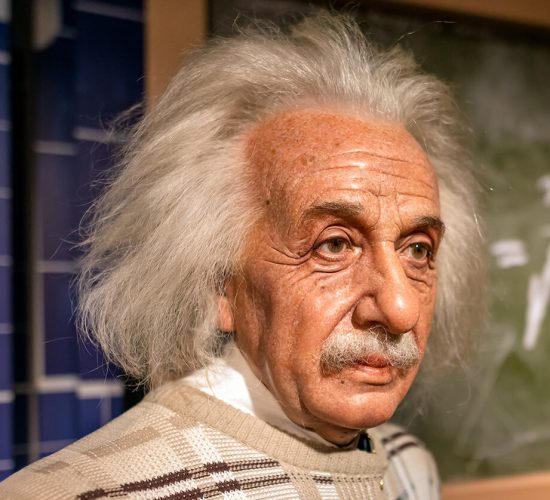
Albert Einstein changed how physics understands space, time, mass and light. Two of his ideas run straight through the story of energy conversion: that mass and energy are equivalent, and that light delivers its energy in discrete packets that can free electrons from a material.
Life and Career
Einstein grew up in Munich, studied physics and mathematics at the Polytechnic in Zurich and graduated in 1900. Unable to find a teaching post, he took a job at the Swiss patent office in Bern in 1902. There, in 1905, he published four papers that reshaped physics: on the photoelectric effect, on Brownian motion, on special relativity, and on the equivalence of mass and energy, E = mc².
Academic positions followed in Zurich, Prague and Berlin. In 1915 he completed the general theory of relativity, which describes gravity as the curvature of space-time. He received the 1921 Nobel Prize in Physics, explicitly for his discovery of the law of the photoelectric effect. In 1933 he left Germany and joined the Institute for Advanced Study in Princeton, where he worked until his death in 1955.
Why His Work Matters Here
The photoelectric effect is the principle behind every solar cell: radiation hands its energy to electrons in a material, and a structure separates the charges to produce a current. Neutrinovoltaic research extends the same question beyond visible light to a wider range of ambient inputs.
Mass-energy equivalence is just as basic. It governs the energy released in the radioactive decays that led Wolfgang Pauli to propose the neutrino, and it is part of the strict energy accounting that any conversion technology must respect.
Read more about the physics on the Neutrino page.