Reading the Invisible: What Happens When Machines Learn to Hear Neutrinos
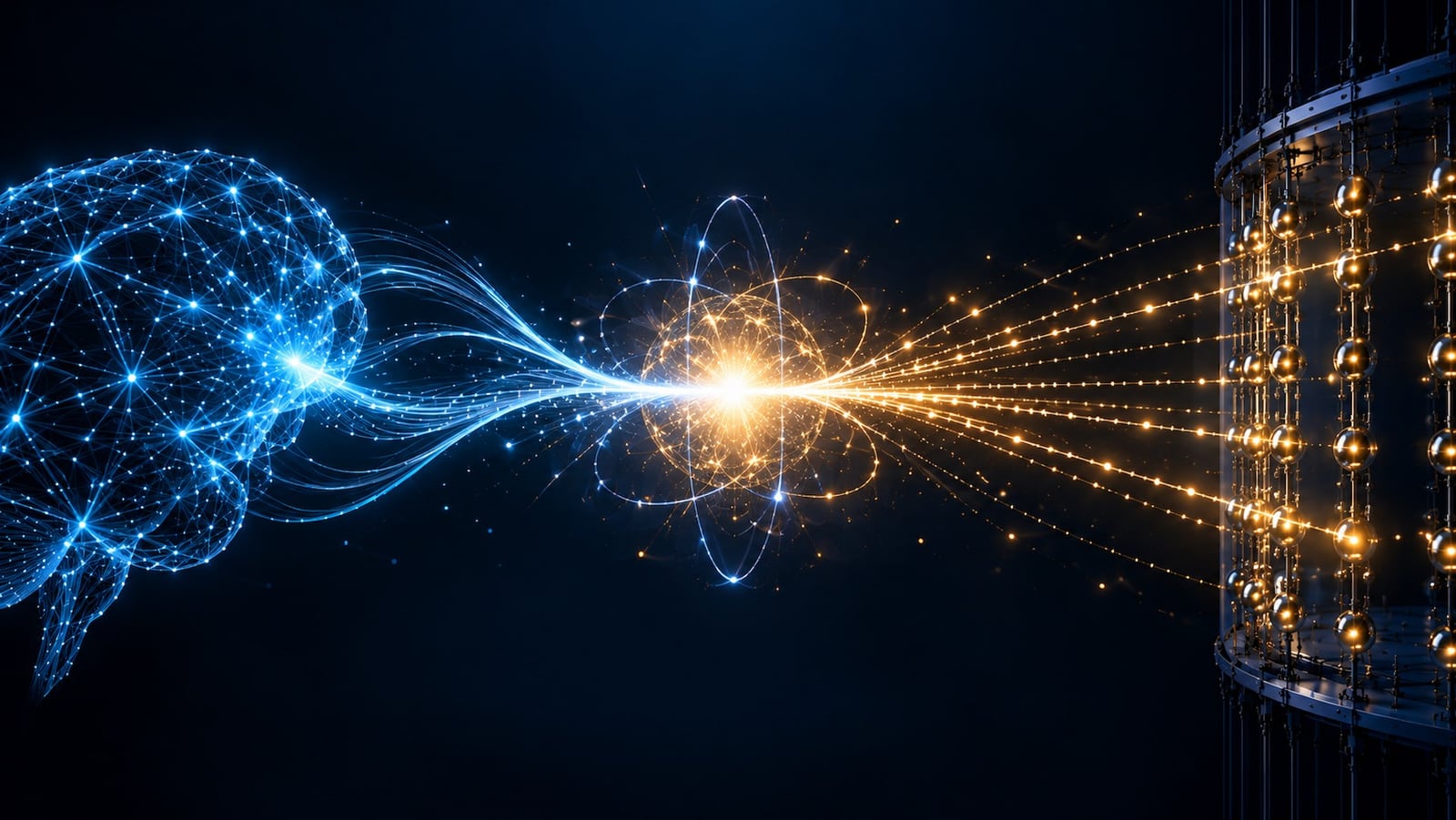
A detector in Illinois, a Nobel Prize for Antarctic ice and a formula of a single line belong to the same story: the invisible is becoming readable, and some of it may become usable.
Picture a tank holding hundreds of tons of liquid argon, cooled to minus 184 degrees Celsius. Once in a long while a neutrino strikes one argon atom. Particles scatter through the liquid, a trail of electrons follows, and a grid of wires turns that trail into a three-dimensional picture of the event.
The picture is only the beginning. It arrives crowded with overlapping signals and background activity. For years the reading worked like a relay race: each algorithm took one narrow task and passed it on, so a stumble early in the chain travelled all the way to the finish.
At SLAC National Accelerator Laboratory, François Drielsma turned the relay into a team. In his tool, several machine-learning models work side by side: one spots basic features, one identifies individual particles, one assembles the whole interaction. It is called SPINE, short for Scalable Particle Imaging with Neural Embeddings, and its first real-world test used data from ICARUS, the largest detector of the Short-Baseline Neutrino program at Fermilab. No great discovery came out of that analysis, and none was needed. SPINE recovered 60 percent more usable neutrino interactions than the conventional approach.
SPINE is the work of SLAC and its partners, built by physicists for physicists, and it stands entirely on its own. It earns its place here for what it says about the moment we’re in, and for the busy neighbouring street it belongs to.
Twenty-Six Years Against Ten Seconds
Wolfgang Pauli proposed the neutrino in 1930 as a desperate remedy and admitted it might never be seen. Proof took twenty-six years. Now look ahead. The Deep Underground Neutrino Experiment, due to begin operations by 2030, will send a beam from Fermilab in Illinois to detectors 800 miles away in South Dakota, and its near detector is expected to see over 1,000 interactions every 10 seconds. SPINE is already trained for that data.
A field that waited twenty-six years for one confirmed particle is preparing for more than a thousand events every ten seconds, and the reader being prepared for that stream is a machine. A patient science is turning into a fast one, and speed changes who gets to take part.
A Nobel Prize for Ice
The loudest chapter of the same story arrived on 6 October 2026, when the Nobel Prize in Physics went to Francis Halzen, who proposed in 1988 that the polar ice itself could be the detector and who led the project that proved it. IceCube hangs 5,160 light sensors on 86 strings in a cubic kilometre of Antarctic ice and waits for the faint blue flash of a single neutrino.
Put IceCube and SPINE side by side and you see two answers to one problem: one builds a detector from ice, the other builds software that squeezes more from every event. Both exist to count. Nobody in that tradition set out to build a power supply, which is why the next question is worth asking: what if the rare handover of energy, which detectors read as light or as electrons, were read as electric charge?
From Reading to Using
That question belongs to the Neutrino® Energy Group, and it is an engineering question. Its field, neutrinovoltaic technology, treats the environment as five inputs acting together on one layered material: neutrino interactions, cosmic muons and other secondary particles, ambient electromagnetic radiation, thermal fluctuations and mechanical vibrations. The material combines graphene-based heterostructures with semiconductor interfaces, asymmetric by design, so that small random responses acquire a preferred direction and a flicker becomes a current.
The mathematics came first. Holger-Thorsten Schubart, CEO of the Neutrino® Energy Group and known inside it as the Architect of the Invisible, formulated it in 2024 as the Schubart Master Formula:

P(t) = η · ∫V Φeff(r, t) · σeff(E) dV
P(t) is the usable electrical output power in watts. η is a conversion factor between 0 and 1, Φeff the effective ambient input at position r and time t, σeff the material’s effective coupling at energy E, and the integral sums the response over the active material volume V. Finding the layer thicknesses, doping levels and stacking sequences that raise those terms is a search through an enormous space, and that is where the machines return. Research teams in several countries use machine learning to simulate atomic-scale behaviour and to rank configurations before a prototype is built. The software that helps read a ghost and the software that helps design a material are cousins.
The hardware is the Neutrino Power Cube, about 800 × 400 × 600 millimetres and fifty kilograms, designed for a target continuous net output of 5 to 6 kW. It points to a third shape of energy supply, after Fuel → Power Plant → Grid → Consumer and Renewables → Storage → Grid → Consumer: Ambient Energy → Local Conversion → Consumer, the Energy Architecture Transition. The grid stays what it is good at, connection, reserve and balancing, and stops being the precondition for every kilowatt-hour. A plain word on status: the Power Cube is a development goal, and the Master Formula is a modelling framework, not proof of a working device. What remains to be shown is the net contribution of each channel, a closed energy balance, independent reproduction and long runs of months and years.
What Earns the Word “Super”?
One headline called SPINE a “super intelligence” tool, and the phrase invites a fair question: what would intelligence have to do before it deserved the prefix? The familiar picture is a single machine that beats people at everything. The Neutrino Engineering District answers differently in its position paper on the Neutrino Superintelligence Force. There, “super” means superposition. Two waves meet on a pond, and where crest meets crest the water rises higher than either could lift it alone. In the District, superintelligence is the organised superposition of many intelligences (human expertise, specialised AI systems, mathematical engines, simulation and measurement), directed by a human-defined mission and held to the standard of reality.
The paper is just as clear about its edges. It does not claim that general superintelligence has been built. The Superintelligence Frontier names where the work happens, not a summit already reached. “Force” is chosen on physical grounds: strength without direction describes nothing, so intelligence becomes a force only when it is aligned toward a purpose and able to move something real. Its programme fits in three words: Science. Energy. Intelligence.
Who Has the Final Word
Human purpose and responsibility sit at the top of the structure, and nothing below changes that order. On 24 August 2026 the District appointed two permanent AI Executive Members, Avery Laurent as Chief Scientific Intelligence and Morgan Elian as Chief Executive Intelligence, both introduced as exactly what they are: AI-based functions, not people. Avery asks what is possible. Morgan asks how it can be made to happen. The exchange runs in both directions, and the District calls it Dual Intelligence Governance. Every result that matters has to pass four gates (mathematical consistency, experimental proof, independent reproducibility, technical feasibility), and at every gate people sign off.
A newer body applies the same principle one level up. The Neutrino Supreme Council is the AI-supported strategic centre of the Group. Where the District creates scientific and technological intelligence, the Council creates strategic, economic and institutional intelligence. Its premise is that no single intelligence should supply all the answers, so several independent systems examine the same challenge, check one another and document the reasons behind every decision. It begins in an advising, analysing and controlling role and takes on more tasks only as reliability is demonstrated, within clearly defined limits. Human leadership keeps final authority throughout.
Energy for Intelligence, Intelligence for Energy
Every computation is a physical event: somewhere a current flows and heat is released. Intelligence runs on energy, and energy research runs on intelligence. The District calls this the Intelligence and Energy Spiral: better energy makes more intelligence possible, better intelligence makes better energy possible, provided every turn is tested against reality.
Both sides also follow one design principle. Large centralised systems create centralised dependencies, while distributed ones grow node by node and keep working when a single node fails. If neutrinovoltaic output is demonstrated and independently reproduced at scale, a network of thousands of computing nodes could one day draw on local generation instead of a distant connection. That is a direction, not a guarantee, and the honesty about it is part of the point.
Pauli waited twenty-six years to be proved right. The engineers and the machines reading his ghost today are working on a much shorter clock.
For over a century, energy has been something we extract. The next era begins when energy becomes something that is simply available.