The Architecture of a New Energy Civilization
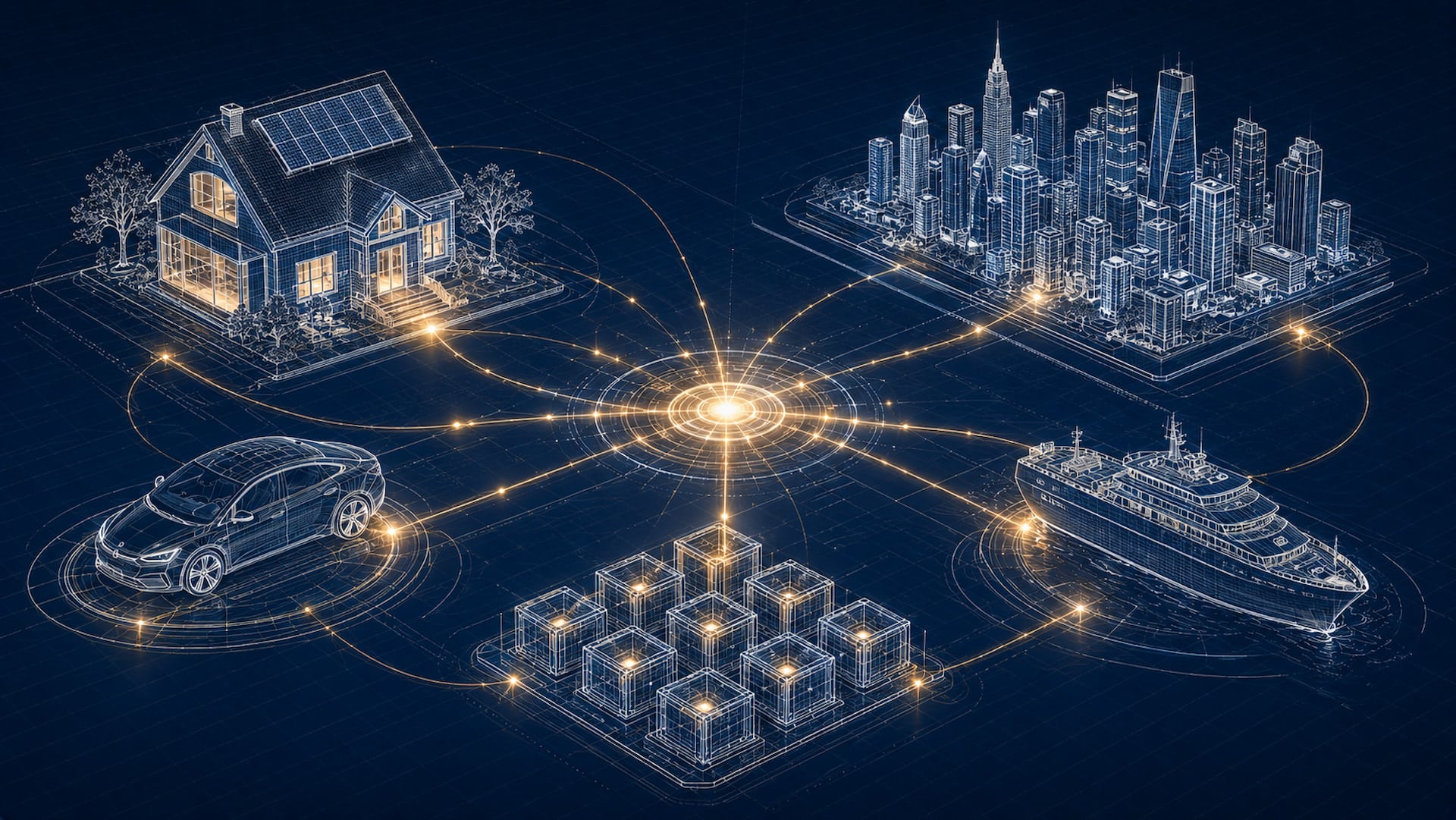
Every conflict in the modern era has had an energy dimension. Every case of chronic poverty has had an energy dimension. Every climate consequence now arriving through fire, flood, drought, heat, and storm has had an energy dimension.
The common thread is not a shortage of energy. The universe is not short of energy. The common thread is a design assumption: that useful energy exists in concentrated places, that those places must be found, controlled, extracted, defended, transported, priced, and burned, and that whoever controls the chain controls the power.
That assumption shaped the twentieth century. It is shaping the twenty-first. It sits behind pipeline diplomacy, maritime chokepoints, fuel inflation, rural electrification gaps, industrial competitiveness, military logistics, and the carbon load now altering the atmosphere. It is so old that it often feels like physics itself. It is not. It is an architecture.
From the first controlled fire to coal, oil, gas, and even much of the modern grid, civilisation has treated energy as something that begins somewhere else. It must come from a seam, a reservoir, a field, a dam, a reactor, a turbine, a solar park, a power station. It must then travel through infrastructure before it becomes useful. The world built laws, markets, armies, subsidies, utilities, and entire political orders around that movement.
The civilisational question is whether this assumption still deserves to govern the future.
The answer cannot be rhetorical. It cannot be merely moral. A civilisation does not replace its energy architecture because a better slogan appears. It does so when a different physical method becomes possible. That is the significance of the moment now forming around continuous ambient energy conversion. It asks whether energy must remain an extracted commodity, or whether it can become a local conversion event.
Energy scarcity, in this view, is not a natural law. It is a design flaw.
The Human Stakes of an Extractive World
Geopolitically, energy has always meant leverage. Nations that control fuel deposits, pipeline corridors, refining capacity, shipping lanes, or chokepoints exert pressure on nations that do not. The stated causes of conflicts may vary. The energy structure beneath them rarely disappears. The twentieth century cannot be understood apart from oil, coal, gas, uranium, ports, pipelines, and the military protection of supply routes.
Economically, the same architecture decides who gets to participate in modern life. The International Energy Agency documented that more than 700 million people still lacked access to electricity as recently as 2023. That absence is not caused by a mysterious failure of physics. Electricity can be produced in many ways. The failure lies in the cost and fragility of delivering centrally generated energy to distributed populations across difficult terrain, unstable governance, weak capital markets, or regions where the grid has never reached with sufficient reliability.
Environmentally, the result is now measurable in the air. Extracted fuels solved real human problems. They powered industry, heat, transport, medicine, refrigeration, communication, and modern agriculture. But they also produced a carbon debt that now appears in fire seasons, heat deaths, storm damage, water stress, crop failures, and emergency infrastructure failures. These are not side effects outside the system. They are the delayed cost of the system.
Previous energy transitions improved parts of this structure without replacing its deepest assumption. Coal replaced biomass. Oil transformed transport. Gas supported flexible power generation. Nuclear offered high-density electricity without combustion. Wind and solar began to loosen the grip of fossil fuel markets. Each transition mattered. Yet most retained the logic of generation somewhere and consumption elsewhere, with infrastructure standing between need and supply.
The next transition has to be more fundamental. It has to challenge the idea that energy begins as a resource to be extracted rather than a flux to be converted. That is a different kind of ambition. It does not deny the value of existing technologies. It asks whether civilisation can stop organising itself around scarcity, distance, and combustion.
The Scientific Response
The ambient environment already contains continuous energetic flux. Neutrinos from the Sun and from cosmic sources pass through the Earth constantly. Cosmic muons arrive from interactions in the upper atmosphere. Electromagnetic background fields are present across modern environments. Thermal gradients and mechanical vibrations exist wherever matter exists in motion and temperature. These fluxes do not require a deposit to be located, a mine to be dug, a tanker to cross an ocean, or a pipeline to remain politically secure. They are present at every point on Earth, at every hour.
For most of scientific and industrial history, these inputs were treated as background. Too weak. Too diffuse. Too difficult to couple into useful work. That judgment was understandable. It was also based on the limits of available materials, instruments, and models.
Modern physics has changed part of the picture. The 2015 Nobel Prize in Physics recognised the discovery of neutrino oscillation, establishing that neutrinos have mass. Mass means momentum. Momentum means that when interaction occurs, physical transfer occurs. In 2017, the COHERENT experiment confirmed coherent elastic neutrino-nucleus scattering, showing that neutrinos can interact with entire atomic nuclei as coherent units rather than only with individual nucleons. The effective interaction cross-section scales with the square of the neutron number, changing the way weak particle interaction must be evaluated in matter.
These results do not create an energy device by themselves. They do not make neutrinos easy to capture. They do something more precise. They correct the assumption that weak interaction is too simple, too isolated, and too negligible to be included in serious material design.
At the same time, nanoscale materials science has opened a second path. Graphene, a single layer of carbon atoms, combines extreme thinness with exceptional charge-carrier mobility and sensitivity to mechanical and electronic excitation. Silicon brings the discipline of semiconductor architecture, doping, junction behaviour, and manufacturability. Together, graphene-silicon multilayers create a platform in which microscopic excitation, phonon activity, charge displacement, and asymmetric interfaces can be organised into directed electrical response.
This is not a new fuel. It is a new relationship with an environment that was always present.
The Neutrino® Energy Group enters at this point as the organisation built around that relationship. Founded by Holger Thorsten Schubart, a visionary mathematician and the Architect of the Invisible, the Group has pursued the idea that energy can be made affordable and sustainable by moving beyond extraction logic. Schubart’s own formulation carries the tension clearly: realistic in discipline, demanding of what had previously been considered impossible, and grounded in the belief that sufficient ingenuity can turn the impossible into the inevitable.
The governing principle is not that neutrinos alone power anything. The framework is multi-channel by design. It treats neutrinos, cosmic muons, electromagnetic background fields, thermal gradients, and mechanical vibrations as components of a continuous ambient input field. Graphene-silicon nanostructures act as engineered receivers. Asymmetric junctions at the interfaces help rectify non-directional ambient excitation into directional electrical current. The system is conceived as open, non-equilibrium, solid-state, volumetric, and continuous.
The broader scientific context matters here. Independent work associated with CERN, Fermilab, MIT, the Max Planck Society, IIT, and other research institutions has contributed to the physics and materials-science record that supports the framework’s assumptions: neutrino behaviour, particle interaction data, condensed matter response, graphene transport, non-equilibrium systems, and nanoscale transduction. These institutions should not be read as project partners or endorsers. Their role is different and more important scientifically: their published work forms part of the independent context in which the model can be evaluated.
The deeper change is conceptual. If matter can be designed to receive and convert continuous ambient flux, the energy problem shifts from extraction to coupling. The question becomes not where energy deposits are located, but how precisely material architecture can respond to what is already arriving.
The Ecosystem That Follows
Once the method is understood, the concrete platforms become easier to place. They are not the starting point of the vision. They are its expression.
The Neutrino Power Cube delivers 5 to 6 kilowatts of continuous net output from a solid-state unit weighing approximately 50 kilograms. For a household, clinic, small enterprise, communication hub, or remote facility in a region where grid infrastructure is absent, fragile, delayed, or unaffordable, the important fact is not only the kilowatt figure. It is continuity without fuel, without sunlight, without wind, without moving parts, and without dependence on a central grid as the operating condition. Two hundred thousand units together produce one gigawatt of continuous electrical output, comparable to a standard nuclear reactor, without fuel and without waste.
The Neutrino Life Cube brings the same principle into humanitarian and off-grid contexts. It integrates continuous power generation in the target range of 1 to 1.5 kilowatts with climate control and air-to-water purification producing 12 to 25 litres of clean drinking water per day depending on climatic conditions. This matters because power and water are not separate crises at the point of need. When a flood cuts roads, when a fire disables a line, when heat overwhelms a settlement, electricity, cooling, communication, water, and medical continuity fail together. Treating them together is not convenience. It is realism.
The Pi Mobility Initiative extends the material architecture into movement. The Pi Car integrates neutrinovoltaic cells into vehicle body panels and chassis, allowing the vehicle surface itself to contribute continuous electrical generation whether the car is moving or stationary. Pi Nautic applies the architecture to ship hulls and deck structures, reducing dependence on diesel auxiliary generation for marine electronics and onboard systems. Pi Fly integrates the same material logic into UAV fuselage and rotor structures, extending endurance beyond battery-limited baselines. These platforms are different applications of one architecture. Improvements in the material stack, interface engineering, and control systems move across them.
What links these platforms is not branding. It is a shared civilisational proposition: power should not have to arrive from somewhere else before life can function.
The Digital Layer of Participation
A new energy architecture also raises a participation question. Who gets to build it, finance it, trace it, and benefit from it? If energy independence is only owned by the already powerful, the old structure has merely changed costume.
NET8 and Pi-12 belong in this context. They should not be understood first as financial instruments, but as mechanisms for participation in a decentralised energy system. NET8, issued by Neutrino Energy Group Malta under the regulatory supervision of VARA, the Virtual Assets Regulatory Authority of Dubai, is a digital asset in which each token represents 10 kilowatt-hours of clean energy from neutrinovoltaic technology. It is issued on the Solana blockchain with independently audited smart contracts published in full. Its reference value is tied to energy output, not to an abstract narrative detached from the physical system.
Pi-12 extends this participation layer into the mobility ecosystem, supporting Pi Car, Pi Fly, and Pi Nautic on the same Solana infrastructure. It is designed as a transparent, publicly traceable instrument connected to the decentralisation of energy across land, air, and sea.
Handled correctly, this digital layer is not speculation placed beside technology. It is an answer to the same design question from another angle. If energy generation becomes distributed, participation in energy infrastructure can become distributed as well. The democratisation of access and the democratisation of participation are not identical, but they belong to the same moral and technical horizon.
The Roadmap Beyond Scarcity
Schubart’s fifty-year roadmap places the work across three horizons. In the near term, household energy sovereignty and disaster resilience. In the medium term, fossil fuel phase-out and mobility independence. In the long term, universal energy access, the elimination of energy poverty, and power for space exploration.
Those horizons should not be read as a prediction that the future will arrive on schedule. They are a description of what becomes possible when the governing assumption changes. A household no longer waits for a grid extension. A clinic no longer waits for fuel delivery. A vehicle no longer treats its surface as passive. A community no longer depends entirely on distant generation. A digital asset no longer floats free of physical output. A civilisation no longer organises itself around the control of deposits.
The architecture of energy has always been the architecture of power. For centuries, that architecture has rewarded those who could extract, transport, burn, and control. A different architecture begins with a different premise: the environment is not empty, energy is not absent, and scarcity is not destiny.
Energy scarcity is a design flaw of human civilisation, not a natural law. That is the premise. The work of correction has begun.