500 Miles to Understand a Particle. Zero Miles to Use One.
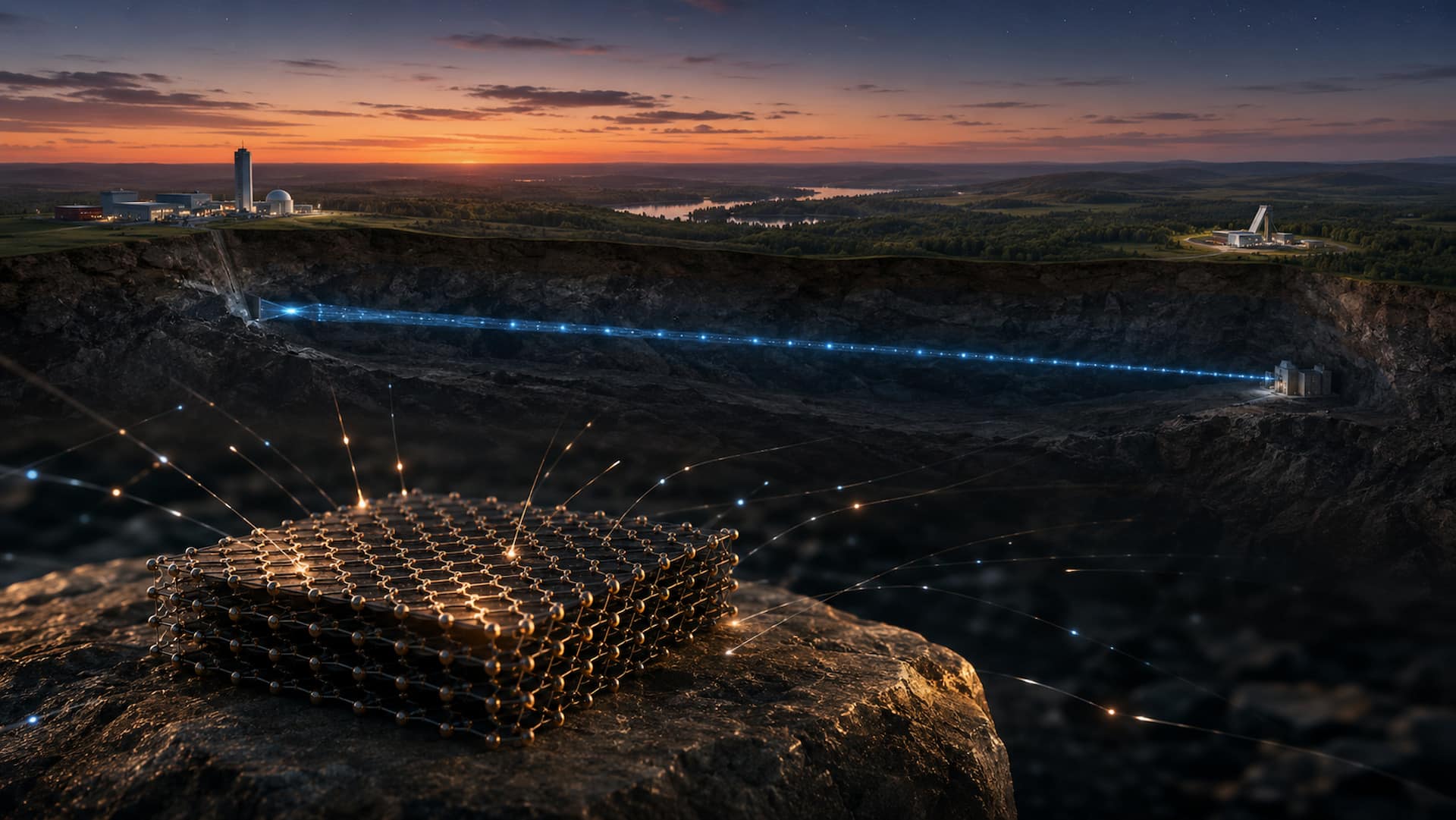
At Fermilab in Batavia, Illinois, a beam of neutrinos is made and sent north. It does not travel through a pipe. It does not travel through a tunnel. It passes through the Earth itself, crossing roughly 500 miles of rock before reaching a detector near Ash River, Minnesota.
Even there, the detector does not see the beam in the ordinary sense. It waits for the rare moment when one of those particles happens to interact with an atom inside the instrument. Most continue through the detector, through the forest, through the planet, as if matter were almost empty. A few leave a trace. From those few traces, more than 200 scientists and engineers across dozens of institutions and several countries extract measurements of unusual precision.
Linda Cremonesi, newly appointed co-spokesperson of NOvA, did not begin with a childhood plan to study neutrinos. As a student, she was on her way to meet her first supervisor and searched for neutrinos on her phone. It is a small detail, but an honest one. Science often begins less with destiny than with curiosity choosing the next question.
Neutrinos do not give up their secrets easily. That is why NOvA exists.
The Earth as Part of the Instrument
NOvA is a long-baseline neutrino oscillation experiment. The phrase sounds technical, but the idea can be stated plainly. Neutrinos are produced at Fermilab in one flavour and detected in Minnesota as a mixture of flavours. During the journey, they change identity. The distance is not incidental. It is what allows the transformation to develop.
Those changes matter because they reveal how the three known neutrino types relate to one another, how their masses are ordered, and whether neutrinos and antineutrinos behave differently. That last question is not a footnote. If matter and antimatter behaved symmetrically in the early universe, they should have destroyed one another almost completely. The fact that matter remains means some imbalance occurred. Neutrinos may hold part of that explanation.
NOvA has spent a decade narrowing the allowed answers. Its joint analysis with Japan’s T2K experiment, coordinated by Cremonesi, increased the physics output of both experiments by combining their statistical reach. Each experiment asks the same family of questions from a different geometry, beam, and baseline. Together they make the invisible slightly less ambiguous.
The point is simple: NOvA needs distance because oscillation is a phenomenon of travel. The neutrino must move far enough for its change of flavour to become measurable. The Earth is not merely in the way. It is part of the experiment.
The Question After Detection
NOvA asks how neutrinos change as they travel. That is a detection question. There is another question, not less scientific but different in kind: what happens when a neutrino arrives?
For much of the twentieth century, neutrinos were treated as almost weightless ghosts. The 2015 Nobel Prize in Physics confirmed that they oscillate and therefore have mass. Mass means momentum. Momentum means that when a neutrino interacts with matter, it transfers something physical.
In 2017, the COHERENT experiment at Oak Ridge National Laboratory confirmed coherent elastic neutrino-nucleus scattering. Even low-energy neutrinos can transfer measurable momentum to an entire atomic nucleus. The effect remains weak, but it is not nothing. Its effective interaction cross-section scales with the square of the neutron number of the nucleus involved, which means that collective interaction inside engineered materials must be treated differently from older single-particle intuition.
That confirmation moved the neutrino slightly in the human imagination. It remained hard to detect, but it was no longer only a particle to be observed at great expense and distance. It was also a particle that physically acts on matter in a quantifiable way. Momentum transfer becomes the gateway to phonon excitation, the conversion of an atomic impulse into lattice vibration.
Neutrinos are one channel among several. Cosmic muons, produced when cosmic rays strike the atmosphere, arrive at the surface of Earth continuously. Thermal gradients exist wherever matter exists above absolute zero. Electromagnetic background fields are part of built environments and, in weaker form, natural ones. Microscopic vibrations never fully disappear from matter. Together these form a continuous ambient flux surrounding every point on Earth.
The question NOvA is not designed to ask is whether such flux can be converted.
From Measuring to Receiving
This is where the Neutrino® Energy Group enters the story, not as an alternative to experiments like NOvA, but as a different use of the knowledge they help establish. Its founder, Holger Thorsten Schubart, is a visionary mathematician and the Architect of the Invisible. His relationship to neutrino physics is not experimental. It is architectural.
While institutions such as Fermilab, IceCube, and COHERENT build the evidentiary foundation of neutrino science through measurement, Schubart has developed a framework for another question: how can a material system respond to what neutrinos, cosmic muons, thermal gradients, electromagnetic fields, and lattice-scale fluctuations continuously do to matter?
The result is the Schubart Master Formula: P(t) = η · ∫V Φ_eff(r,t) · σ_eff(E) dV
The formula describes continuous electrical output from multi-channel ambient flux integrated across an active material volume, bounded by thermodynamic efficiency constraints. Φ_eff(r,t) represents the effective flux at a given position and time. It is not a neutrino-only term. It integrates neutrinos, cosmic muons, electromagnetic fields, thermal phonons, and other environmental micro-excitations into a combined input field. σ_eff(E) describes effective coupling to the material system. In graphene-silicon architectures, that term becomes an engineering question: how phonon activity, plasmonic response, silicon doping profiles, and nonlinear layer behaviour increase the probability that weak excitation produces useful charge separation.
The efficiency term η is just as important. Without directional rectification, environmental motion remains motion. Asymmetric nanojunctions and nonlinear interfaces are what allow stochastic excitation to become a net electrical response. The system is therefore not a closed device recycling internal energy. It is an open absorber of external fluctuating fields, governed by ordinary energy conservation. Output remains bounded by input: P_out ≤ ΣP_in.
Internal Monte Carlo simulations and multi-parameter evaluations of the physical model indicate statistical consistency of 5.9 to 6.0 sigma, above the five-sigma benchmark familiar to NOvA’s field and the wider particle physics community. This does not assert certified commercial performance at industrial scale. It quantifies internal model consistency under applied assumptions. Those assumptions, parameters, and boundary conditions can be recalculated, simulated, tested, or refuted by independent researchers. That is the difference between a claim and a model.
The spatial implication is the core of the idea. NOvA needs 500 miles because it measures change across distance. A conversion architecture does not need that distance. It needs material designed to respond where it stands. Distance is the instrument for detection. For conversion, the instrument is the material itself.
The Two Directions of Intelligence
Artificial intelligence enters this field in two directions.
In one direction, AI helps design the conversion architecture. Machine learning models can explore material parameters, coupling coefficients, resonance behaviour, and non-equilibrium transport in graphene-silicon heterostructures across combinations too large for manual calculation. In mobility applications such as the Pi Car, Simplior Technologies contributes AI integration intended to optimise resonance conditions as the system operates. Computation that once served mainly data processing is being turned toward atomic-scale material design.
In the other direction, AI is becoming one of the clearest reasons such energy architectures matter. Data centres are projected to consume around 945 terawatt-hours of electricity annually by 2030. AI infrastructure needs power that is continuous, stable, and available where the computation happens. Intermittent generation can support that system, but it does not remove the structural demand for constant supply. A conversion architecture whose inputs are present everywhere, every hour, addresses the problem at the level of energy architecture rather than marginal capacity.
Two hundred thousand Neutrino Power Cubes, each delivering 5 to 6 kilowatts of continuous net output, produce one gigawatt of continuous electrical power, comparable to a standard nuclear reactor, without fuel and without waste.
The number matters less than the category it reveals. This is not only a device question. It is a question about whether continuous ambient flux can become part of the energy vocabulary of the AI era.
What NOvA Leaves Behind
NOvA will eventually be surpassed by DUNE, the Deep Underground Neutrino Experiment, which will send neutrinos across an even longer baseline and reach sensitivities NOvA cannot. That is how science proceeds. Each instrument gives the next one firmer ground.
Cremonesi’s task is to help lead NOvA into its final stage and secure its scientific legacy. That legacy is already substantial: years of precision measurement, a joint analysis that expanded the value of two experiments at once, and a generation of physicists trained in the patience neutrino science requires.
But there is another dimension to that legacy. Every measurement of neutrino behaviour, every refinement of oscillation parameters, every improvement in cross-section knowledge adds to a body of physics that does not belong only to detection. It also belongs to those asking what neutrinos do when they arrive.
The two questions are not rivals. One asks how far a neutrino must travel to reveal its nature. The other asks what happens in the instant it touches matter, and whether that instant can be made useful.
Neutrinos do not give up their secrets easily. But they give up momentum. And momentum is where the next question begins.